
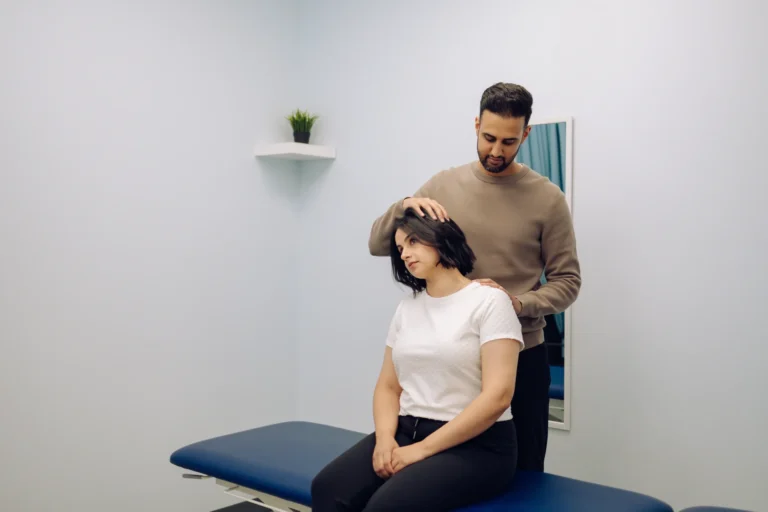
The Importance of Spinal Mobility for Strength Training and Gym Performance
Why Spinal Mobility Matters for Strength Training
Strength training requires more than strong muscles — it requires a body that moves well. Restricted spinal mobility affects your ability to:
- Squat
- Deadlift
- Press overhead
- Row
- Lunge
- Maintain posture
- Brace your core
A stiff spine limits performance and increases risk of injury.
At Dr. Harman Braich, Chiropractic, operating out of Creekwood Physiotherapy, we help patients improve spinal mobility to optimize movement quality, reduce pain, and enhance gym performance.
What Is Spinal Mobility?
Spinal mobility is the ability of the vertebrae, surrounding joints, and supporting musculature to move freely and efficiently.
Ready for Relief?
Book Your AppointmentIt depends on:
- Joint flexibility
- Tissue elasticity
- Controlled muscular coordination
- Nervous system responsiveness
When any of these are limited, movement quality declines — especially during loaded exercises.
Why People Lose Spinal Mobility
Several lifestyle factors contribute to restricted spinal movement:
Sedentary Lifestyle & Work Demands
Long sitting stiffens the thoracic spine, weakens stabilizers, and restricts rib motion.
Stress-Induced Muscle Tension
Stress can increase protective muscle guarding, especially in the neck, back, and shoulders.
Previous Injuries
Old injuries create compensations and persistent mobility restrictions.
Have Questions?
We're Here to Help!Inefficient Training Habits
Training without addressing mobility reinforces dysfunctional patterns.
Cold Weather Effects
Research suggests that cold environments may decrease neuromuscular efficiency and increase muscle tension
(Renberg et al., 2020).
Winter stiffness is a real barrier to strong and safe lifting.
How Spinal Mobility Affects Strength Training
Here’s how limited mobility impacts key movements:
Squats
Poor spinal mobility may cause:
- Excessive forward lean
- Rounding of the lower back
- Hip/knee overloading
- Difficulty achieving depth
- Poor bracing patterns
Deadlifts
Deadlifts require coordinated spinal stability and hip hinge mechanics.
Stiffness may lead to:
- Early lumbar flexion
- Overactive spinal erectors
- Limited hip loading
- Increased risk of strain
Overhead Pressing
Overhead lifts demand proper thoracic extension.
When mobility is limited, people compensate by:
- Arching their lower back
- Shrugging through the shoulders
- Overloading the spine
Pulling Movements
Poor thoracic mobility limits scapular movement, leading to:
Looking to Get Started?
Book Online Today!- Neck tension
- Overuse of the upper traps
- Reduced pulling strength
Split Stance & Single-Leg Movements
Lunges, step-ups, and single-leg deadlifts require:
- Rotation control
- Spinal alignment
- Hip mobility
Restricted mobility = unstable movement patterns.
How Chiropractic Care May Improve Spinal Mobility
A comprehensive chiropractic approach may help restore movement and enhance training performance. At Dr. Harman Braich, Chiropractic, spinal mobility care includes:
Restoring Joint Movement Through Adjustments
Chiropractic adjustments may restore natural movement to restricted spinal segments
(Chiropractic Care).
Improved mobility supports better technique and reduces compensations.
Early research suggests these adjustments may influence proprioception and movement coordination
(Learman et al., 2009).
Reducing Muscle Tension and Guarding
Soft-tissue therapy improves muscle flexibility, reduces trigger points, and enhances movement.
This benefits:
- Neck tension
- Mid-back stiffness
- Lower back tightness
- Hip flexor and hamstring tightness
Relaxed muscles allow smoother, more controlled lifts.
Supporting Proprioception and Body Awareness
Proprioception helps maintain:
Start Your Journey!
Book With Us Today- Neutral spine alignment
- Core bracing
- Balance under load
- Safe lifting mechanics
Some early research suggests chiropractic care may support sensorimotor control (Rogers, 1997).
Improving Functional Movement Patterns
Through exercise-based rehabilitation (Rehabilitation & Exercise Therapy), patients receive:
- Thoracic extension drills
- Hip hinge progressions
- Core activation sequences
- Overhead mobility exercises
- Rotational stability work
These improve movement quality in the gym.
Correcting Imbalances and Asymmetries
Common asymmetries include:
- One hip tighter
- One shoulder more mobile
- Subtle spinal curvature
- Dominant-side muscle patterns
Chiropractic care helps identify and address these imbalances for better performance.
Complementing Gym Training With Additional Modalities
Depending on your assessment, additional therapies may help:
- Shockwave Therapy – chronic tendon tightness
- Spinal Decompression Therapy – lower-back irritation
- Custom Foot Orthotics – lower-limb alignment
- Dry Needling & Acupuncture – persistent muscular tension
Your Chiropractor’s Athletic Background Enhances Performance Care
As a former elite soccer player and captain of the University of Alberta Golden Bears, Dr. Braich brings:
- High-level biomechanics knowledge
- Understanding of performance movement
- Injury-prevention strategies
- Strength and mobility expertise
This athletic foundation benefits every patient — beginner or advanced.
Signs Your Spinal Mobility Is Limiting Performance
- Difficulty maintaining neutral spine
- Rounding during deadlifts or squats
- Shoulder pain during pressing
- Limited overhead mobility
- Mid-back tightness when lifting
- Movement plateaus
- Persistent stiffness
These are strong indicators that a mobility-focused chiropractic assessment may help.
Tips to Improve Spinal Mobility
- Include daily thoracic mobility exercises
- Strengthen your deep core
- Train hip hinge patterns
- Use dynamic warm-ups before workouts
- Incorporate rotational movement
- Avoid prolonged sitting
- Stay hydrated
- Book chiropractic mobility tune-ups every 4–6 weeks
Localized Care for Southwest Edmonton Residents
At Dr. Harman Braich, Chiropractic, located within Creekwood Physiotherapy, we proudly serve:
- Creekwood Chappelle & Chappelle Gardens
- Ambleside, Keswick & Windermere
- Glenridding Heights & Glenridding Ravine
- Heritage Valley, Paisley, Desrochers & Jagare Ridge
- Rutherford, Callaghan, Allard, Cavanagh & Blackmud Creek
- Richford, Macewan & Blackburne
We help active adults, beginners, and athletes improve strength, mobility, and performance.
Your Path to Better Performance Starts With Better Mobility
A strong spine is important — but a mobile spine is essential. Improving spinal mobility may help you lift better, move better, and perform with confidence.
Visit braichchiro.com to book your spinal mobility and performance assessment today.
Research & References
- Learman KE et al. Effects of spinal manipulation on trunk proprioception. J Manipulative Physiol Ther. 2009.
https://pubmed.ncbi.nlm.nih.gov/19243723/ - Rogers RG. Effects of spinal manipulation on cervical kinesthesia. J Manipulative Physiol Ther. 1997.
https://pubmed.ncbi.nlm.nih.gov/9046455/
Renberg J et al. Effect of working position and cold environment on muscle activation and neuromuscular efficiency. Ergonomics. 2020.
https://www.sciencedirect.com/science/article/pii/S0169814119306043