Shockwave Therapy for Tendon Pain: When It May Help and When Rehab Still Matters
Tendon pain can be one of the more frustrating problems for active adults.
It often starts quietly. A bit of heel pain during the first few steps in the morning. A nagging Achilles tendon after running. Elbow pain with gripping, lifting, or racquet sports. Shoulder pain that shows up with pressing, reaching, or throwing. At first, it may feel manageable. You rest for a few days, symptoms settle, and then the pain returns as soon as you increase activity again.
That cycle is common with tendon-related problems.
Many people assume tendon pain means the tissue simply needs rest. Rest can sometimes calm symptoms temporarily, but it does not always solve the underlying issue. Tendons are load-sensitive tissues. They usually need the right amount of loading, recovery, and progression to improve their ability to tolerate activity over time.
Ready for Relief?
Book Your AppointmentThis is where shockwave therapy may be useful for some patients. Shockwave therapy, also called extracorporeal shockwave therapy or ESWT, uses acoustic pressure waves applied to the affected area. In musculoskeletal care, it is commonly discussed for conditions such as plantar fasciitis, Achilles tendinopathy, patellar tendinopathy, tennis elbow, golfer’s elbow, and certain shoulder tendon conditions.
But shockwave therapy should not be framed as a stand-alone cure or a shortcut around rehab. For many tendon problems, the more realistic approach is to combine symptom-focused care with progressive loading, movement education, and a plan that matches the person’s actual demands.
At Dr. Harman Braich, Chiropractor, operating out of Creekwood Physiotherapy in Southwest Edmonton, shockwave therapy is considered as one possible tool within a broader evidence-informed plan — not as a replacement for assessment, rehab, or load management.
What Is Shockwave Therapy?
Shockwave therapy is a non-invasive treatment that delivers mechanical acoustic waves into targeted tissues. In clinical practice, it is often used for persistent tendon-related pain, plantar fascia pain, and certain musculoskeletal conditions.
There are different forms of shockwave therapy, including radial and focused shockwave. These differ in how energy is delivered into tissue, the depth of treatment, and the type of clinical application. A 2022 best-practice review in musculoskeletal medicine describes ESWT as a treatment used across several musculoskeletal conditions and emphasizes that clinical decision-making should consider diagnosis, patient selection, treatment parameters, and safety considerations.
In simple terms, shockwave therapy is not “breaking up scar tissue” in the way many patients are sometimes told. That explanation is too simplistic. Research has explored several potential mechanisms, including effects on pain modulation, local tissue response, cellular signalling, and tendon-related healing processes. However, the exact mechanisms are still not fully settled, and clinical outcomes can vary depending on the condition, chronicity, protocol, and patient factors.
Have Questions?
We're Here to Help!That uncertainty does not mean shockwave therapy has no value. It means it should be used thoughtfully, with realistic expectations.
Why Tendon Pain Often Keeps Coming Back
Tendon pain is often less about one isolated incident and more about a mismatch between tissue capacity and demand.
For example:
A runner increases mileage too quickly.
A soccer player returns to sprinting after time off.
A gym-goer increases pressing, pulling, or jumping volume.
A desk worker develops elbow pain from repeated gripping, mouse use, or lifting.
A person starts walking more in summer after being less active during winter.
A parent repeatedly lifts children, strollers, groceries, and bags without enough recovery.
In each case, the tendon may be asked to tolerate more load than it is currently prepared for.
Looking to Get Started?
Book Online Today!Pain may settle with rest because the irritated tissue is no longer being challenged. But if the tendon’s capacity has not improved, symptoms can return when the same activity is reintroduced.
That is why tendon rehab often needs more than rest. It usually requires a plan to gradually reload the tendon in a way that improves tolerance without repeatedly provoking flare-ups.
For Achilles tendinopathy specifically, the 2024 clinical practice guideline update describes tendon loading exercise as a first-line treatment approach to improve pain and function in appropriate patients. This supports a broader principle that applies to many tendon problems: passive care may help symptoms, but progressive loading is often central to longer-term improvement.
When Shockwave Therapy May Be Considered
Shockwave therapy may be considered when tendon-related pain has become persistent, especially when symptoms are limiting activity and have not responded well to basic rest, stretching, or generic exercise advice.
Common examples include:
Plantar fasciitis or plantar heel pain
Achilles tendon pain
Patellar tendon pain
Tennis elbow
Golfer’s elbow
Start Your Journey!
Book With Us TodayRotator cuff or shoulder tendon-related pain
Hip tendon pain in some cases
The evidence varies by condition. Some reviews suggest ESWT may be helpful for certain lower-limb tendinopathies, though the strength of evidence differs depending on the diagnosis and study quality. A British Journal of Sports Medicine systematic review concluded that low-level evidence suggests ESWT may be effective for some lower-limb conditions across phases of rehabilitation.
More recent consensus recommendations published in the British Journal of Sports Medicine state that shockwave and/or pressure wave therapy can be considered as part of treatment algorithms for various tendinopathies, plantar fasciopathy, and some other musculoskeletal conditions.
That wording matters: “part of the treatment algorithm” does not mean “the only treatment needed.”
For a patient with tendon pain, shockwave therapy may be used to help reduce pain sensitivity and support the rehab process. But the patient still needs a plan for loading, progression, and return to activity.
Why Rehab Still Matters
A tendon that hurts with stairs, running, lifting, jumping, gripping, or sport usually needs to regain tolerance to those activities.
That does not happen through passive treatment alone.
Rehab helps answer questions such as:
What load can the tendon currently tolerate?
Which movements are painful but acceptable?
Which loads are too much right now?
How often should exercises be performed?
When should weight, speed, range, or volume increase?
How do we return to running, jumping, lifting, or sport?
How do we avoid underloading or overloading the tendon?
This is where rehab and exercise therapy becomes important. The goal is not simply to prescribe a few generic exercises. The goal is to choose the right starting point and progress gradually.
For some patients, early rehab may involve isometric loading, slower resistance exercises, or modified ranges of motion. For others, the plan may need to progress toward heavier strength work, plyometrics, running drills, cutting, jumping, sport-specific work, or occupational demands.
For Achilles tendinopathy, conservative management literature emphasizes a staged approach where exercise begins early for symptom management and load reduction, while sport-specific loading is progressed later.
That same principle applies broadly: the rehab plan should match the stage of the problem and the demands of the person.
Shockwave Therapy Is Not a Replacement for Load Management
One of the biggest mistakes with tendon pain is treating the painful area while ignoring the load pattern that created or maintained the issue.
If someone has plantar heel pain but continues to sharply increase walking volume, footwear changes, hill walking, or running intensity, symptoms may keep returning.
If someone has Achilles tendon pain but continues sprinting or jumping before the tendon is ready, shockwave therapy alone is unlikely to solve the problem.
If someone has tennis elbow but continues high-volume gripping, lifting, racquet sport, or repetitive tool use without modification, the tissue may stay irritated.
Load management does not mean complete rest. It means adjusting the amount, intensity, frequency, and type of stress placed on the tendon so it can adapt.
That might include:
Temporarily reducing running volume
Modifying gym exercises
Changing grip position or load
Using pain monitoring during rehab
Spacing out aggravating activities
Adjusting footwear or walking volume
Gradually rebuilding rather than restarting at full intensity
This is often the missing piece. Patients may receive treatment, feel better, and then return too quickly to the same workload that irritated the tendon in the first place.
What Conditions Commonly Respond Better?
The evidence is not equal across all tendon conditions.
Shockwave therapy has been studied most often for conditions such as plantar fasciitis, Achilles tendinopathy, patellar tendinopathy, lateral elbow tendinopathy, and calcific shoulder tendinopathy.
For plantar fasciitis, NICE states that evidence raises no major safety concerns, but there remains uncertainty about how well the procedure works, and patients should be informed about that uncertainty.
That is a useful reminder for clinical practice. Shockwave therapy may be reasonable, but it should be presented honestly. Some patients respond well. Some respond partially. Some may need a different approach.
For patellar tendinopathy, the evidence is mixed. One systematic review on combined ESWT and exercise found that study quality and protocols vary, which makes it difficult to provide one universal conclusion across all cases.
For Achilles tendinopathy, the strongest foundation remains progressive tendon loading. Shockwave therapy may be considered in selected cases, but it should not replace strengthening, education, and gradual return to activity.
Who Might Be a Good Candidate?
A patient may be a reasonable candidate for shockwave therapy if:
The pain appears tendon-related or plantar fascia-related.
Symptoms have persisted despite basic rest or self-management.
The condition is limiting activity, training, work, or daily function.
There is no urgent medical concern or red flag presentation.
The patient understands that shockwave is part of a broader plan.
The patient is willing to follow a rehab and load-management strategy.
A patient may be less suitable if the symptoms are very acute, the diagnosis is unclear, the pain is primarily nerve-related, there are signs of a more serious condition, or there are contraindications to treatment.
A proper assessment matters because not every painful heel, elbow, shoulder, or Achilles is the same. Heel pain may involve the plantar fascia, nerve irritation, fat pad sensitivity, stress injury, inflammatory conditions, or other causes. Elbow pain may involve tendon irritation, joint sensitivity, nerve involvement, or referred pain from the neck. Shoulder pain may involve tendon, joint, cervical spine, or other contributing factors.
The treatment should match the assessment.
Safety and Contraindications
Shockwave therapy is generally considered non-invasive, but that does not mean it is appropriate for everyone.
Best-practice guidance and reviews discuss contraindications and precautions such as certain clotting disorders, treatment over areas of infection or tumour, pregnancy-related precautions depending on treatment location, and other clinical considerations.
Side effects are usually temporary and may include soreness, redness, bruising, or discomfort during treatment, but patients should be screened and informed before care begins. A review focused on plantar fasciitis reported that ESWT is likely safe for plantar fasciitis, while also noting the need for better reporting of protocols, patient characteristics, and side effects.
This is why shockwave therapy should not be used casually or without a clinical assessment. The clinician should explain why it is being considered, what the alternatives are, what the risks are, and how progress will be measured.
What to Expect From a Shockwave Therapy Plan
A shockwave therapy plan should usually begin with a clear assessment, not just pointing to the sore spot and treating it.
The appointment may include:
History of the problem
Review of activity, training, work, and aggravating factors
Movement or strength testing
Palpation of the painful region
Screening for other possible sources of pain
Discussion of whether shockwave is appropriate
Explanation of realistic expectations
A rehab or load-management plan
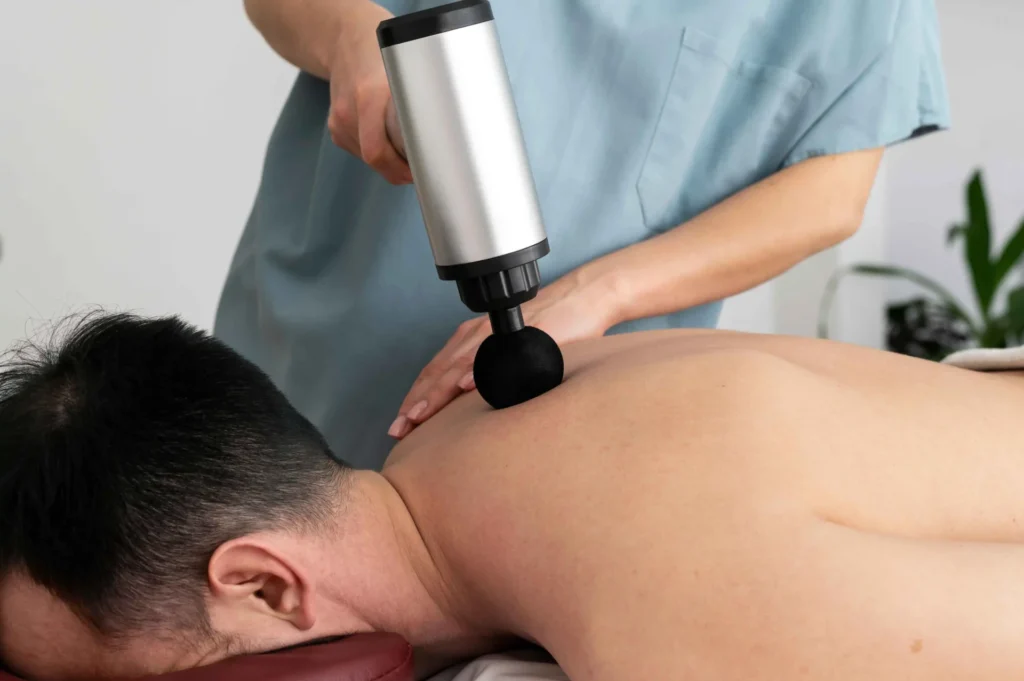
The treatment itself usually involves applying the shockwave device to the target area for a set number of pulses or treatment time, depending on the protocol. Patients may feel tapping, pressure, or discomfort during treatment. The intensity should be tolerable and adjusted to the patient and condition.
After treatment, the plan should still include guidance on what to do next. That may involve avoiding a sudden spike in activity, continuing rehab exercises, monitoring symptoms, and progressing gradually.
The Bigger Goal: Building Tendon Capacity
The goal of tendon care is not just to make the painful area feel better temporarily.
The bigger goal is capacity.
Can the Achilles tolerate running, stairs, and sport?
Can the plantar fascia tolerate walking, work shifts, or summer activity?
Can the elbow tolerate gripping, lifting, tools, or racquet sports?
Can the shoulder tolerate pressing, reaching, throwing, or work demands?
That is where the combination of assessment, shockwave therapy when appropriate, rehab exercise, and load management becomes more useful than any single treatment alone.
For active adults, this matters because the goal is rarely just “less pain at rest.” The goal is returning to the activities that matter — walking, running, training, golf, soccer, work, parenting, or recreational sport — with more confidence and fewer setbacks.
Localized Care for Southwest Edmonton Residents
Dr. Harman Braich, Chiropractor provides chiropractic care, rehab-focused treatment, and shockwave therapy for patients in Southwest Edmonton while operating out of Creekwood Physiotherapy. This includes residents from Creekwood Chappelle, Chappelle Gardens, Chappelle, Ambleside, Keswick, Windermere, Glenridding Heights, Glenridding Ravine, Heritage Valley, Paisley, Desrochers, Jagare Ridge, Rutherford, Callaghan, Allard, Cavanagh, Blackmud Creek, Richford, Macewan, and Blackburne.
For local patients, convenience can make consistency easier. Tendon pain often requires follow-through, not just one appointment. Being close to home, work, school drop-off, or your usual commute can make it easier to attend care, complete rehab, and progress gradually.
When to Book an Assessment
Consider booking an assessment if you have tendon pain that keeps returning with activity, heel pain that is worse with the first few steps in the morning, Achilles pain with running or jumping, elbow pain with gripping or lifting, or shoulder tendon pain that limits training or daily tasks.
You do not need to wait until symptoms are severe. Early assessment can help clarify what is likely happening, what should be modified, and whether shockwave therapy, rehab, hands-on care, or another approach makes the most sense.
Final Thoughts
Shockwave therapy may be a useful option for certain tendon-related conditions, but it works best when used thoughtfully.
Tendon pain is rarely solved by simply resting forever or treating the sore spot without addressing why it became overloaded in the first place. For many patients, long-term improvement requires a combination of symptom management, progressive loading, education, and realistic activity progression.
At Dr. Harman Braich, Chiropractor, the focus is on evidence-informed care that helps patients understand their pain, improve movement tolerance, and build capacity over time.
Call today or visit braichchiro.com to schedule your chiropractic assessment with Dr. Harman Braich.
Research & References
Tenforde et al. (2022). Best practices for extracorporeal shockwave therapy in musculoskeletal medicine. This review discusses ESWT use in musculoskeletal conditions, treatment considerations, and safety.
Rhim et al. (2025). Recommendations for use of extracorporeal shockwave therapy in sports medicine and musculoskeletal conditions. This expert consensus discusses terminology, treatment parameters, contraindications, and use of shockwave/pressure wave therapy as part of treatment algorithms.
Korakakis et al. (2018). The effectiveness of extracorporeal shockwave therapy in lower-limb tendinopathy. This BJSM review concluded that low-level evidence suggests ESWT may be effective for some lower-limb tendinopathies.
Chimenti et al. (2024). Achilles pain, stiffness, and muscle power deficits clinical practice guideline. This guideline describes tendon loading exercise as a first-line treatment approach for appropriate Achilles tendinopathy patients.
Silbernagel et al. (2020). Conservative management of Achilles tendinopathy. This review emphasizes staged loading, symptom management, and progressive return to sport-specific loading.
NICE HealthTech Guidance 200. Extracorporeal shockwave therapy for refractory plantar fasciitis. NICE states there are no major safety concerns, but evidence on efficacy is inconsistent and patients should be informed of uncertainty.
Roerdink et al. (2017). Complications of extracorporeal shockwave therapy in plantar fasciitis. This review reports ESWT is likely safe for plantar fasciitis but calls for better reporting of protocols and side effects.
Auersperg and Trieb (2020). Extracorporeal shockwave therapy: an update. This review discusses mechanisms, indications, and contraindications.