Golf Season Back Pain in Edmonton: Why It Happens and How to Prevent It
When the snow melts in Edmonton, golf courses fill quickly.
For many adults in Southwest Edmonton, golf season represents more than recreation — it is competition, stress relief, and social connection. Unfortunately, it is also one of the most common times of year for back pain flare-ups.
Research suggests low back pain is one of the most frequently reported injuries in golfers (Sugaya et al., 2019). The golf swing places high rotational and compressive loads through the lumbar spine, especially when conditioning does not match demand.
At Dr. Harman Braich, Chiropractor, operating out of Creekwood Physiotherapy in Southwest Edmonton, care focuses on helping active adults build rotational capacity — not just manage symptoms.
Ready for Relief?
Book Your AppointmentThis article explains:
- Why golf stresses the lower back
- Common movement limitations that increase risk
- Why “just stretching” often fails
- How to prepare your body for the season
Why Golf Is Demanding on the Lower Back
The modern golf swing generates significant rotational velocity. Biomechanical studies suggest that compressive forces in the lumbar spine during the downswing can exceed several times body weight (Gluck et al., 2008).
Key demands of the swing include:
- Rapid trunk rotation
- Dissociation between hips and thorax
- Controlled deceleration after ball contact
- Repeated asymmetric loading
If hip mobility is limited, the lumbar spine may compensate.
Over time, repeated microloading without adequate preparation may irritate joints, discs, or surrounding musculature.
The Most Common Causes of Golf-Related Back Pain
1. Limited Hip Internal Rotation
Research suggests restricted hip mobility is associated with increased lumbar rotation during golf (Vad et al., 2004).
Have Questions?
We're Here to Help!If hips do not rotate efficiently:
- Lumbar segments absorb more torsion
- Facet joints may become irritated
- Muscle guarding increases
Hip mobility is often overlooked in weekend golfers.
2. Poor Thoracic Spine Mobility
The thoracic spine is designed for rotation. If mid-back mobility is reduced:
- Lumbar rotation increases
- Swing mechanics become less efficient
- Fatigue develops earlier in the round
Restoring thoracic mobility may redistribute load more appropriately.
3. Inadequate Core Endurance
Research suggests trunk endurance may be protective in athletes exposed to repeated rotational load (McGill, 2007).
Golf requires:
- Anti-rotation control
- Controlled acceleration
- Deceleration strength
Maximal strength alone is not enough. Endurance under repeated load matters.
4. Sudden Volume Increase in Spring
A common Edmonton scenario:
- Minimal winter rotational training
- First warm weekend
- 18–36 holes played
- Pain develops 24–72 hours later
This is a classic load–capacity mismatch.
The tissues were not progressively conditioned.
Looking to Get Started?
Book Online Today!Why Stretching Alone Often Fails
Many golfers respond to stiffness with aggressive stretching.
While mobility work has value, research suggests passive flexibility does not automatically translate to improved load tolerance (Behm et al., 2016).
Stretching without strength and endurance training may:
- Increase range without control
- Reduce stiffness temporarily
- Fail to build rotational resilience
Preparation must include strength, coordination, and graded exposure.
The Role of Chiropractic Care
Manual therapy may help reduce pain and improve mobility in certain cases of low back discomfort (Paige et al., 2017).
Within a broader plan, Chiropractic Care may help:
- Improve joint motion
- Reduce local sensitivity
- Restore rotational symmetry
However, passive care alone is rarely sufficient for sustained performance.
Building Rotational Capacity: A Movement-Based Plan
Effective prevention typically includes:
1. Hip Mobility Work
- Internal rotation drills
- Split-stance mobility progressions
- Controlled rotational patterns
2. Thoracic Rotation Training
- Open-book drills
- Half-kneeling rotation
- Rib mobility sequencing
3. Anti-Rotation Strength
- Pallof variations
- Cable holds
- Offset carries
4. Gradual Volume Ramp-Up
- Start with range sessions
- Limit early-season holes
- Increase weekly volume incrementally
Structured Rehabilitation & Exercise Therapy programs are individualized to swing mechanics and physical capacity.
What About Disc or Nerve Irritation?
If symptoms include:
Start Your Journey!
Book With Us Today- Radiating leg pain
- Numbness or tingling
- Morning stiffness that improves with movement
Further evaluation is appropriate.
In select cases, Spinal Decompression Therapy may be considered.
Imaging findings must always be interpreted cautiously, as degenerative changes are common in asymptomatic individuals (Brinjikji et al., 2015).
When Lower Limb Mechanics Matter
Foot stability influences swing mechanics.
If force transfer through the ground is inefficient, rotational stress may increase upstream.
In certain cases, Custom Foot Orthotics may help improve load distribution.
These are not necessary for everyone — but assessment determines relevance.
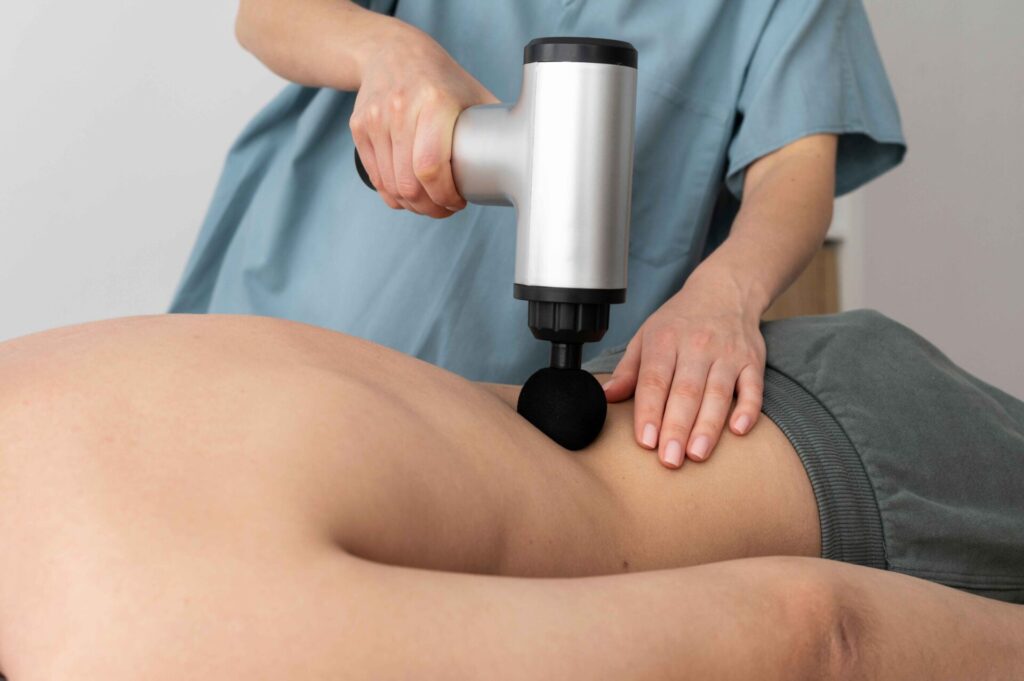
Shockwave and Dry Needling: When Are They Used?
Persistent muscle irritation or tendon overload may respond to adjunctive therapies.
Options include:
These are integrated selectively within a broader rehabilitation plan.
Early Signs You Should Not Ignore
Consider assessment if:
- Pain appears after every round
- One-sided low back tightness persists
- You feel restricted during backswing
- You rely on frequent pain medication
Early intervention may reduce season disruption.
Localized Care for Southwest Edmonton Residents
Dr. Harman Braich, Chiropractor proudly serves:
Creekwood Chappelle & Chappelle Gardens
Ambleside, Keswick & Windermere
Glenridding Heights & Glenridding Ravine
Heritage Valley, Paisley, Desrochers & Jagare Ridge
Rutherford, Callaghan, Allard, Cavanagh & Blackmud Creek
Richford, Macewan & Blackburne
Operating out of Creekwood Physiotherapy in Southwest Edmonton, care is focused on keeping active adults performing confidently.
Final Thoughts
Golf back pain is rarely random.
It is usually the result of:
- Rotational demand
- Load spikes
- Mobility restrictions
- Insufficient endurance
With the right preparation, most golfers can play consistently without recurring flare-ups.
If you are preparing for the season or managing recurring discomfort, visit the All Services Page to learn more or book directly at braichchiro.com.
Research & References
Behm DG, et al. Acute effects of static stretching on muscle performance: systematic review. Appl Physiol Nutr Metab. 2016.
Brinjikji W, et al. Imaging features of spinal degeneration in asymptomatic populations. AJNR Am J Neuroradiol. 2015.
Gluck GS, et al. The lumbar spine and low back pain in golf. Clin Sports Med. 2008.
McGill SM. Low back stability: from formal description to issues for performance and rehabilitation. Exerc Sport Sci Rev. 2007.
Paige NM, et al. Spinal manipulative therapy for acute low back pain. JAMA. 2017.
Sugaya H, et al. Epidemiology of golf-related injuries. Orthop J Sports Med. 2019.
Vad VB, et al. Low back pain in golfers: role of hip mobility. Am J Sports Med. 2004.