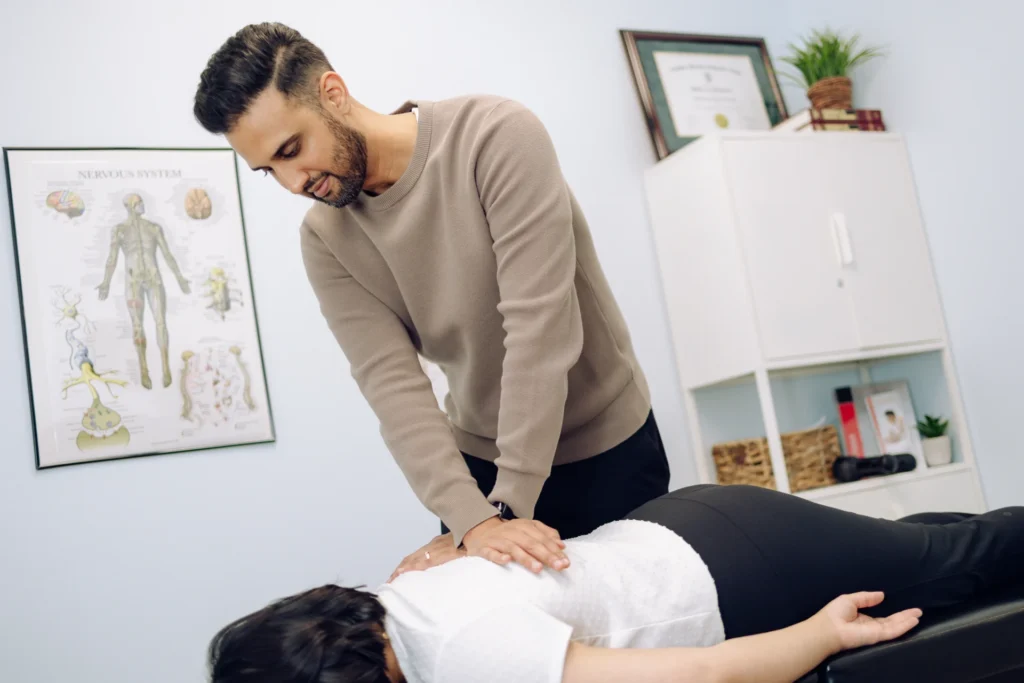
Why Your Back Hurts After Long Drives (And What to Do About It)
It’s a familiar pattern.
You get through the drive feeling fine — maybe a bit stiff, but nothing concerning. Then you step out of the car, straighten up, and something doesn’t feel right. Tightness, a sharp catch, or that dull ache in your lower back that lingers the rest of the day.
By the next morning, it’s worse.
This is one of the most common complaints during early summer in Edmonton. Weekend trips, longer commutes, and road travel all increase time spent sitting — often in the same position for hours at a time.
Ready for Relief?
Book Your AppointmentResearch suggests prolonged sitting is associated with increased risk of low back discomfort, particularly when movement variability is low (Lis et al., 2007). But the issue isn’t just “sitting is bad.”
It’s how long, how often, and how prepared your body is for that position.
At Dr. Harman Braich, Chiropractor, operating out of Creekwood Physiotherapy in Southwest Edmonton, the focus is on helping people tolerate real-life demands — including long drives — without recurring flare-ups.
What Actually Happens During a Long Drive?
Driving places your body in a sustained, slightly flexed position:
- Hips are flexed
- Spine often settles into a rounded posture
- Movement is minimal
- Muscle activity becomes low-level and sustained
Over time, several things may happen:
- Joint stiffness increases
- Muscle endurance decreases
- Disc pressure may rise in flexed positions (Callaghan & McGill, 2001)
- Blood flow and tissue variability are reduced
None of these are inherently harmful in short durations.
Have Questions?
We're Here to Help!But when exposure is prolonged — especially without breaks — tolerance becomes the limiting factor.
Why You Don’t Feel It Until You Get Out of the Car
This is the part most people find confusing.
If sitting is the issue, why does the pain show up after?
Two main reasons:
1. Reduced Movement Masks Symptoms
While sitting, the spine is relatively still. There is little demand for change or adaptation.
Once you stand:
- The spine has to extend
- Muscles re-engage
- Joints move through previously unused ranges
If tissues have stiffened, that transition can trigger symptoms.
2. Temporary Desensitization
Low-level sustained positions may reduce awareness of discomfort temporarily.
When movement resumes, sensitivity returns — sometimes more noticeably.
This is why people often say:
Looking to Get Started?
Book Online Today!“It didn’t hurt during the drive — only after.”
It’s Not Just Your Back
One of the most overlooked contributors is the hip.
During prolonged sitting:
- Hip flexors remain shortened
- Gluteal activity is reduced
- Hip extension becomes limited
When you stand and walk:
- The lumbar spine may compensate for reduced hip motion
- Load shifts to the lower back
- Tightness or pain appears
This is often why stretching the back alone doesn’t solve the issue.
The Load–Capacity Problem
This comes back to a simple principle:
Your body can tolerate what it is prepared for.
If you regularly sit for long periods, your body adapts.
If you don’t — and suddenly do a 2–4 hour drive — the demand exceeds your current capacity.
Research suggests that rapid increases in mechanical load without adaptation are associated with symptom development in musculoskeletal conditions (Foster et al., 2018).
Start Your Journey!
Book With Us TodayThis is why:
- Occasional long drives feel worse than daily commuting
- Weekend trips trigger flare-ups
- People feel “fine” until they aren’t
Why “Fixing Your Posture” Isn’t the Full Answer
You’ve probably heard:
“Sit up straight.”
“Fix your posture.”
Posture matters — but not in the way most people think.
There is no single “perfect posture.”
Research suggests that variability in posture is more important than maintaining one ideal position (O’Sullivan et al., 2012).
Trying to sit perfectly upright for hours often leads to:
- Fatigue
- Increased muscle tension
- Reduced movement variability
A better approach is:
- Change positions frequently
- Introduce small movements
- Take breaks
What Actually Helps During Long Drives
1. Breaks Matter More Than Position
Taking a break every 45–90 minutes may help:
- Restore movement variability
- Reduce stiffness
- Improve circulation
Even 2–3 minutes of walking can make a difference.
2. Change Your Position Slightly
Instead of holding one posture:
- Adjust seat angle periodically
- Shift weight
- Use small lumbar support changes
Micro-movements reduce cumulative load.
3. Pre-Drive Preparation
Before long drives, simple preparation may help:
- Hip mobility drills
- Light core activation
- Short walk
This “primes” the system for sustained positioning.
What to Do If Pain Keeps Coming Back
If symptoms happen after every long drive, that’s a pattern — not a coincidence.
This usually indicates:
- Limited hip mobility
- Reduced trunk endurance
- Low tolerance to sustained positions
- Incomplete recovery from prior episodes
A structured plan becomes important.
Where Chiropractic Care Fits
Manual therapy may provide short-term relief for low back discomfort (Paige et al., 2017).
Chiropractic Care may help:
- Improve joint mobility
- Reduce stiffness
- Restore movement confidence
But long-term change comes from improving capacity — not just reducing symptoms.
Building Tolerance to Sitting (Yes, It’s Trainable)
Most people think they just need to avoid sitting.
In reality, your body can be trained to tolerate it better.
This may include:
- Gradual exposure to longer sitting durations
- Core endurance training
- Hip mobility work
- Movement variability strategies
A tailored Rehabilitation & Exercise Therapy program helps bridge that gap.
When Symptoms Suggest Something More
Seek assessment if you experience:
- Pain radiating into the leg
- Numbness or tingling
- Progressive worsening after each drive
- Difficulty standing upright after sitting
In select cases, further management strategies such as Spinal Decompression Therapy may be considered.
Adjunctive Support (When Needed)
Depending on the presentation:
- Dry Needling & Acupuncture may help reduce muscle sensitivity
- Shockwave Therapy may be used for persistent soft tissue irritation
- Custom Foot Orthotics may be considered if lower limb mechanics contribute
These are used selectively, not routinely.
Localized Care for Southwest Edmonton Residents
Dr. Harman Braich, Chiropractor proudly serves:
Creekwood Chappelle & Chappelle Gardens
Ambleside, Keswick & Windermere
Glenridding Heights & Glenridding Ravine
Heritage Valley, Paisley, Desrochers & Jagare Ridge
Rutherford, Callaghan, Allard, Cavanagh & Blackmud Creek
Richford, Macewan & Blackburne
Operating out of Creekwood Physiotherapy in Southwest Edmonton, care is designed to help you stay active — whether that’s on the road, in the gym, or on the field.
Final Thoughts
Back pain after long drives is rarely about a single structure.
It’s usually a combination of:
- Sustained positioning
- Reduced movement variability
- Load exceeding current tolerance
The goal isn’t to avoid sitting completely.
It’s to build a body that can handle it.
If long drives consistently leave you stiff or sore, it may be time to address the underlying capacity — not just the symptoms.
To learn more or book an assessment, visit the All Services Page or head directly to braichchiro.com.
Research & References
Callaghan JP, McGill SM. Low back joint loading and kinematics during sitting. Ergonomics. 2001.
Foster NE, et al. Prevention and treatment of low back pain: evidence and challenges. Lancet. 2018.
Lis AM, et al. Association between sitting and occupational low back pain. Eur Spine J. 2007.
O’Sullivan PB, et al. What do we mean by posture? Br J Sports Med. 2012.
Paige NM, et al. Spinal manipulative therapy for acute low back pain. JAMA. 2017.